
What Counts as a “Point of Entry and Exit”? The Most Consequential Ambiguity in Fla. Stat. 768.0706

What Counts as a “Point of Entry and Exit”?  The Most Consequential Ambiguity in Fla. Stat. 768.0706

Of the seven physical security measures itemized in Fla. Stat. 768.0706(2)(a), the first appears to be the simplest: a security camera system at points of entry and exit that records, and maintains as retrievable for at least 30 days, video footage sufficient to assist in identifying and apprehending offenders. Property owners read that sentence, count their entrance drives, and check the box. On simple properties with a handful of clearly identified entrance drives and sidewalks, this type of simplified analysis may be accurate. However, on many properties, that reading can be easily misleading. The statute never defines what constitutes a “point of entry and exit,” and the answer a property assumes can differ dramatically from the answer a plaintiff’s attorney will argue after an incident.

What does Fla. Stat. 768.0706(2)(a)(1) actually require?

The requirement has three components, and each carries its own compliance exposure. The camera system must cover the property’s points of entry and exit; footage must remain retrievable for at least 30 days; and the recorded image quality must be sufficient to assist in identifying individuals or vehicles passing through those points. The second and third components are operational conditions rather than installation specifications — a system that met them on installation day can quietly fall out of compliance as cameras are added and storage becomes inadequate, imaging quality deteriorates, or vegetation grows. But it is the first component, the coverage requirement, that contains the statute’s most consequential undefined term.

The ambiguity of the term “point of entry and exit”

The statute provides no definition, and until Florida courts resolve the question through case law, no one can say with certainty where the requirement ends. What can be said with certainty is who bears the risk of guessing wrong: the statute places the burden of proof on the owner or principal operator to demonstrate substantial implementation of the required measures. A property that counted conservatively and covered three points will not be arguing with us about the definition. It will be arguing with an opposing expert who is inclined to count expansively, under deposition, after an incident occurred when the presumption against liability hinges on the court’s interpretation of “substantial compliance.” That asymmetry is why our team applies a prudent working assumption: any designed point of passage between exterior public space and the private space of the property may qualify as a “point of entry and exit” under the statute.

What does a prudent approach to camera coverage and Fla. Stat. 768.0706(2)(a)(1) encompass?

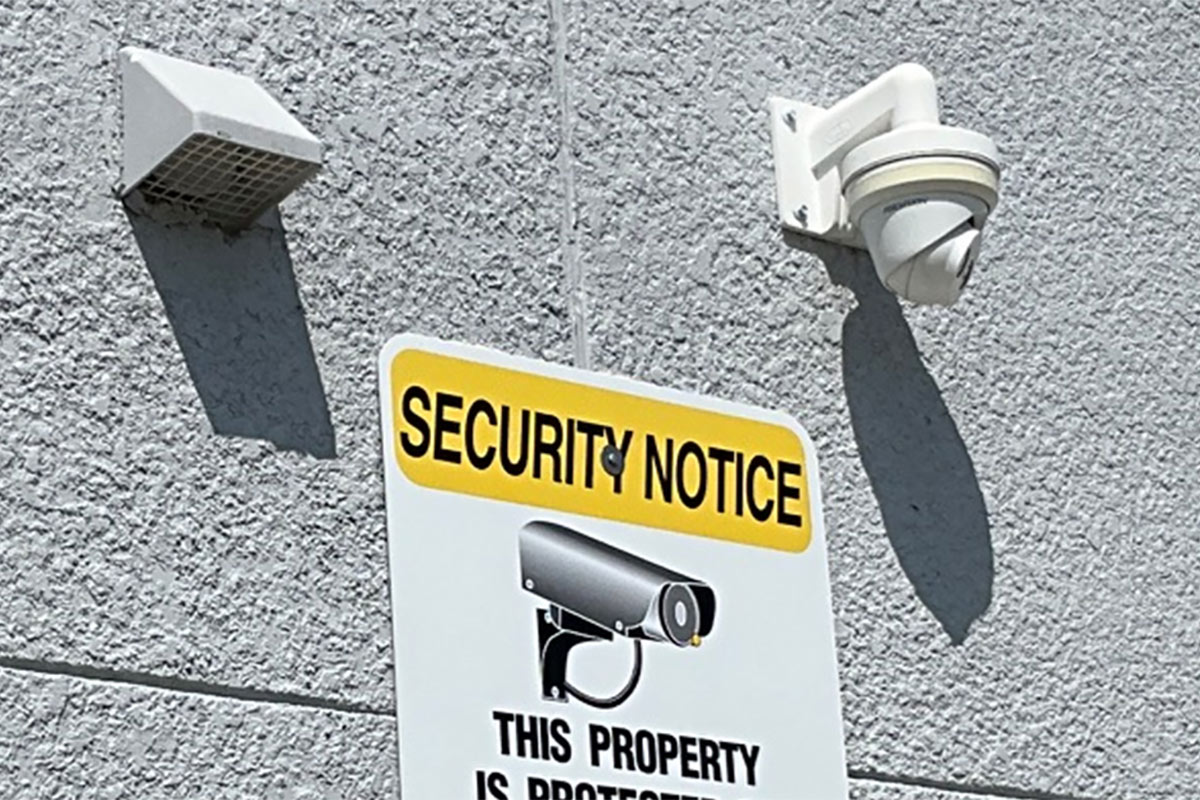
Applied in the field, the assumption may encompass more than owners expect. Every vehicle entrance drive qualifies. So does every sidewalk entering the property from exterior public space — pedestrian points of passage are “points of entry and exit” in every sense that matters to the statute’s purpose. Where unofficial entry points exist, such as a foot trail worn through the property line, prudence may justify measures to prevent future foot traffic or covering those as well: the path’s existence demonstrates that people use it. And for vertical properties in urban settings, exterior doors adjacent to public space — a building entrance opening directly onto a public sidewalk — may also qualify. The common thread is the property line/legal boundary: the analysis begins not with where management assumes people enter, but with every designed crossing between public and private space.

The property that went from three points to twenty

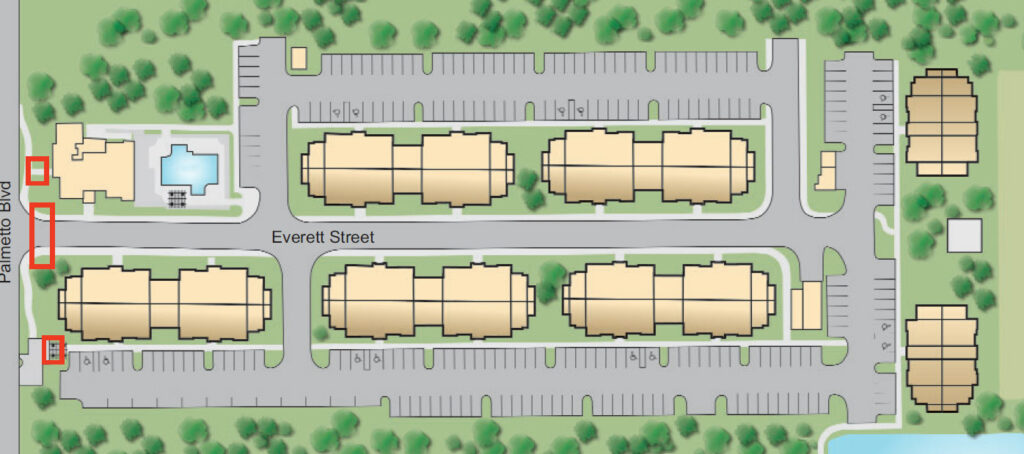
This counting problem is illustrated well by a case from our assessment practice. At first glance, the property (a garden-style community) appeared to have three points of entry and exit: two sidewalks entering from the boulevard on its western boundary, and one entry road with adjacent sidewalks. Three points, three cameras, straightforward compliance.
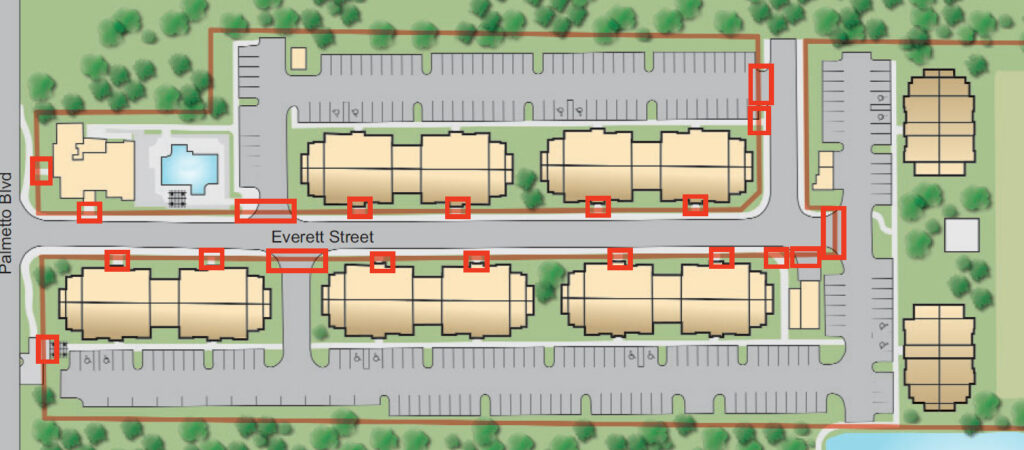
However, examination of the property appraiser’s map told a different story. The street running through the middle of the community was not a private drive — it was a public road, dividing the property into two separate sections, and the sidewalks along it were public space as well. Once the property’s actual boundaries were established, every vehicle entrance from that road and every sidewalk approaching the breezeways of the buildings along it became possible “points of entry and exit.” The complete count was twenty.
An even more complex situation arises often with high-rise apartment properties built in structural adjacency to commercial facilities and public parking garages. In several properties we’ve assessed of this type, the number of “points of entry and exit” ranged between 28 and 36 when all doors connecting public areas from the private inner space of the property were tallied.

To be clear, these cases are outliers — most properties we assess have between one and seven qualifying points under our interpretation guidelines. But the example demonstrates why the count must be established from the property’s legal boundaries (as defined by the property appraiser’s map) or careful analysis of floor plans where relevant.

What does undercounting potentially cost?

The obvious cost is the corrective one: in our recent findings analysis of 30 Florida multifamily properties, camera coverage gaps at points of entry and exit appeared on 77% of properties, and camera system corrections ranged from roughly $2,000 for coverage additions to $50,000 or more where systems required replacement.

The less obvious cost is the evidentiary one. A property that undercounted has not merely left a gap in coverage — it has created the precise fact pattern that undermines defensible compliance with Fla. Stat. 768.0706(2)(a)(1): an uncovered point of passage and a record that shows the property drew the definitional line in its own favor. The expense of covering a marginal point is knowable and bounded. The expense of defending the decision not to cover it is neither.

Counting is the beginning, not the end

Identifying the points is the first half of compliance; keeping them covered is the second. Retention must survive operational reality, and every new camera added to a system shrinks the retention window for all of them. Image quality must actually support identification at each covered point, which is a nighttime question as much as a resolution question. And vegetation is the quiet saboteur: trees and shrubbery that were not pruned with camera sight lines in mind can partially or fully obstruct coverage of a “point of entry and exit.” The most common scenarios are overgrown trees blocking a camera’s view of an entry drive or sidewalk where it crosses the property line, converting a covered point into an uncovered one without anyone touching the camera system. Property staff should know the location of every designated point, verify weekly that each camera covering one is functioning and unobstructed, and generate a work order immediately when one is not.

Where this fits in your compliance sequence

The point-counting analysis belongs at the beginning of the compliance process — during the preliminary review, before any formal assessment documents the property’s conditions. Counting honestly at that stage lets a property correct coverage gaps before they become findings in a discoverable report. Our compliance guide explains the preliminary assessment sequence in detail, and our practitioners perform this boundary analysis as a standard component of every 768.0706 engagement. If your property’s count was established by assumption rather than analysis, it is worth revisiting. And preferably before a plaintiff has a reason to count for you.

Contact Us 

Contact us for a free consultation about Fla. Stat. § 768.0706 compliance by calling Tel. +01 (727) 461-9417 or by completing the following form:
Craig

Budgeting for Compliance: What Florida CPTED Assessments Under F.S. 768.0706 Actually Find—and What Corrections Cost

Budgeting for Compliance:  What Florida CPTED Assessments Under F.S. 768.0706 Actually Find—and What Corrections Cost

In July 2023, I authored an article examining what property owners and managers should expect when commissioning a CPTED assessment for compliance with Florida Statute 768.0706. I followed that up in 2024 with a six-part compliance guide examining the entire process from initial cost-benefit analysis through establishing a sustainable compliance management process. Both publications were aimed at answering the big procedural questions—what the statute requires, the assessment process, and how to bolster defense against challenge by plaintiffs. But procedural guidance answers only half of what an owner needs to know before committing to this process. The question we field most frequently—often during our first phone call—is far more practical: What are you likely to find on my property, and what will it cost to fix?

Until recently, my honest answer was anecdotal—informed by years of assessments but never quantified. While preparing for an upcoming conference presentation, I conducted an analysis of 30 sample properties assessed by CIS under F.S. 768.0706 to quantify which compliance deficiencies and CPTED problems appear most frequently during these assessments. I then paired those findings with remediation cost data harvested from actual client project records and from Ecofi, a lighting design firm we’ve worked with on remediation projects for multiple clients. Following are the results, along with practical advice for anticipating improvement costs when budgeting for the compliance process.

A few words about the sample before we proceed. The 30 properties consist of Florida multifamily and senior living communities selected with a type and size distribution representative of the 291 properties we assessed as of the date of the analysis. The set encompasses 26 existing properties and four newly-constructed properties—spanning garden-style, mid-rise, and bungalow-style communities with unit counts ranging from 33 to 528. Urban high-rise buildings were omitted from the dataset to avoid contaminating the analysis, since they tend to have a distinctly different pattern of conditions.

The sample skews heavily toward affordable and tax-credit housing (20 of 30 properties), with four public housing/special program properties and only two market-rate communities, so the averages presented here should not be read as representative of the Florida multifamily market as a whole. Subgroup figures at small sample sizes are directional, not definitive. Withstanding these limitations, the patterns across the sample are consistent enough to support useful budgeting guidance. In total, our assessments documented 1,491 distinct issue instances across the 26 existing properties.

Every Existing Property Failed Something

Let’s begin with the finding that matters most for anyone entering this process with expectations of a clean report: all 26 existing properties in the sample—100%—had at least one deficiency at initial assessment against the security measures enumerated in F.S. 768.0706(2)(a). Not most. All of them. And these were not neglected properties; the sample includes well-managed communities with attentive maintenance staff and recently-renovated sites. Twenty-six of twenty-six is not a statistic that leaves much room for optimism about your property being the exception.

The good news is that a deficiency finding is not a compliance failure—it is the starting point of the compliance process. The statute’s presumption against liability rewards owners who identify deficiencies, remediate them, and document the work. In this respect, the assessment report should be understood as a remediation planning document, and the records generated during correction should be maintained for discovery purposes if a court challenge ever arises. For budgeting purposes, the practical implication is simple: owners should enter the assessment process with a corrective budget line already anticipated, not discover the need for one when the report arrives. The balance of this article is aimed at helping predict what that line item may contain.

The Statutory Compliance Scorecard: What Fails and What Doesn’t

F.S. 768.0706(2)(a) enumerates seven defined security measures for the “premises”: a security camera system at “points of entry and exit” with 30-day video retention, a lighted parking lot maintaining an average of 1.8 foot-candles at 18-inches above the surface, walkway and common-area lighting from “dusk until dawn,” 1-inch deadbolts on dwelling unit doors, locking devices on windows and exterior sliding doors, locked gates with key or fob access at pool fence areas, and peepholes or door viewers on unit doors lacking adjacent windows.

As a starting point, unit-level hardware requirements are rarely the problem. In our sample, non-compliant deadbolt locks appeared at exactly one property out of 26 (3.8%). Non-compliant window locks: also one property (3.8%). And in the latter case, the problem wasn’t missing locks, but rather worn locks that couldn’t function for their intended crime prevention purpose under the statute. Florida’s multifamily housing stock is, as a general matter, already built and maintained to these hardware requirements. Obstructed door viewers appeared somewhat more often (six properties, 23.1%)—typically the result of paint or accumulated dirt—but this is a maintenance-and-policy correction, not a capital expense.

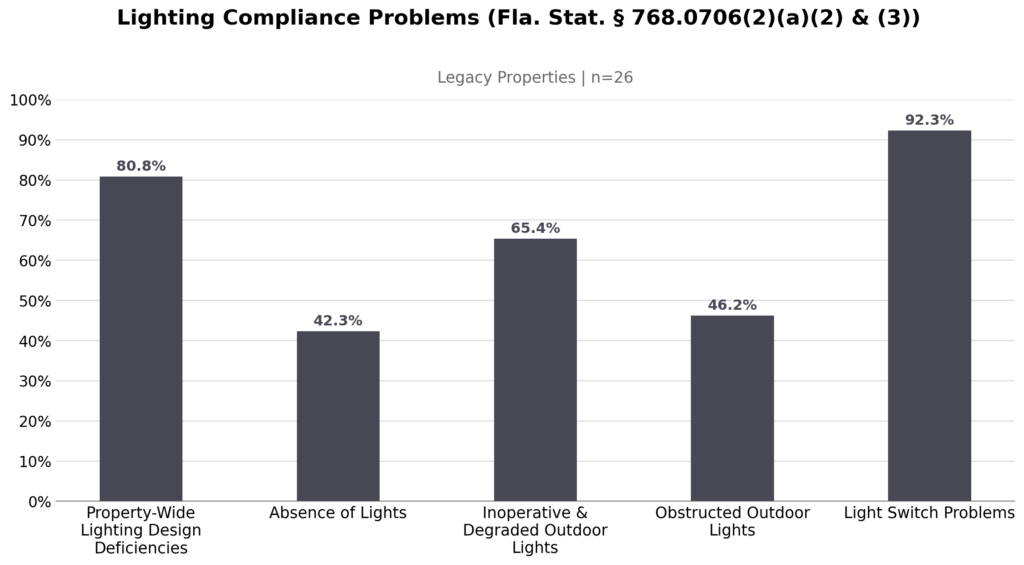
Some of the most frequent problems are unglamorous ones. Light switch problems appeared at 24 of 26 existing properties (92.3%). This finding deserves explanation, because it catches nearly everyone off guard. The statute requires illumination of walkways, laundry rooms, common areas, and porches from “dusk until dawn”—but on property after property, we find that lighting serving these areas is often controlled by unsecured wall switches accessible to residents and the public, or by motion sensors and timers that interrupt illumination during the required period. A light that anyone can switch off is a light that cannot be relied upon to satisfy a “dusk until dawn” requirement, and a plaintiff’s expert will make exactly that argument. Unsecured switches were the third most prevalent individual problem in the entire dataset, appearing at 26 of 30 properties (86.7%) including the new construction. The corrections—locked switch/thermostat boxes or hard-wiring circuits to the electrical panel—are individually inexpensive, but they are ubiquitous.

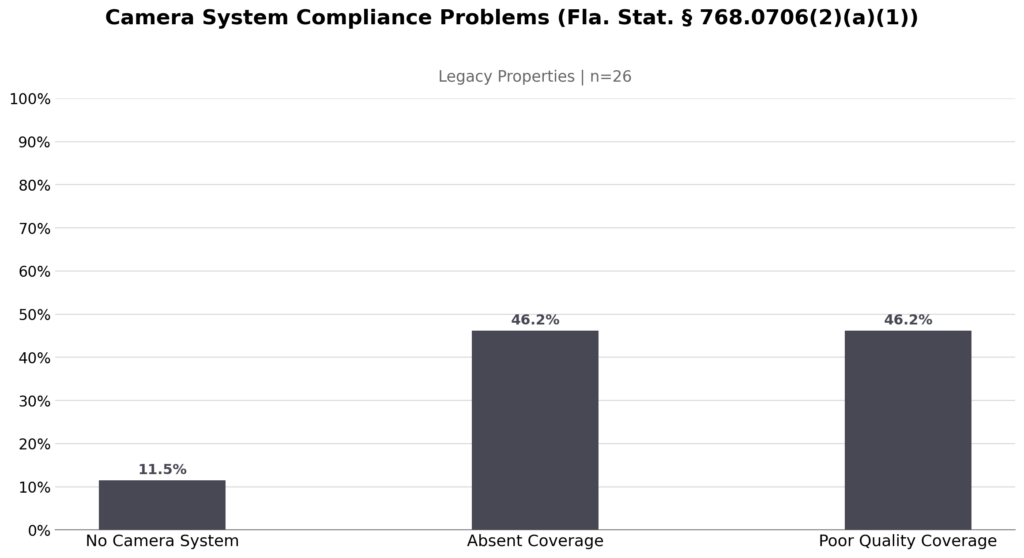
Pool gate deficiencies appeared at half of the existing properties (13 of 26)—unsecured gates, child safety locks unlocked and unattended during daytime hours, and broken latches. And camera system deficiencies were nearly as widespread: 20 of 26 existing properties (76.9%) had at least one camera-related finding. Only three properties (11.5%) lacked a camera system entirely, but 12 properties (46.2%) had absent coverage at one or more “points of entry and exit,” and an equal number had coverage of such poor quality—aged cameras, connectivity problems, inadequate resolution at the distances involved—that it could not reasonably serve the statute’s evident purpose. Simply put, most properties have cameras; far fewer have the type and quality of coverage expected under the statute.

Lighting: The Big Ticket Item

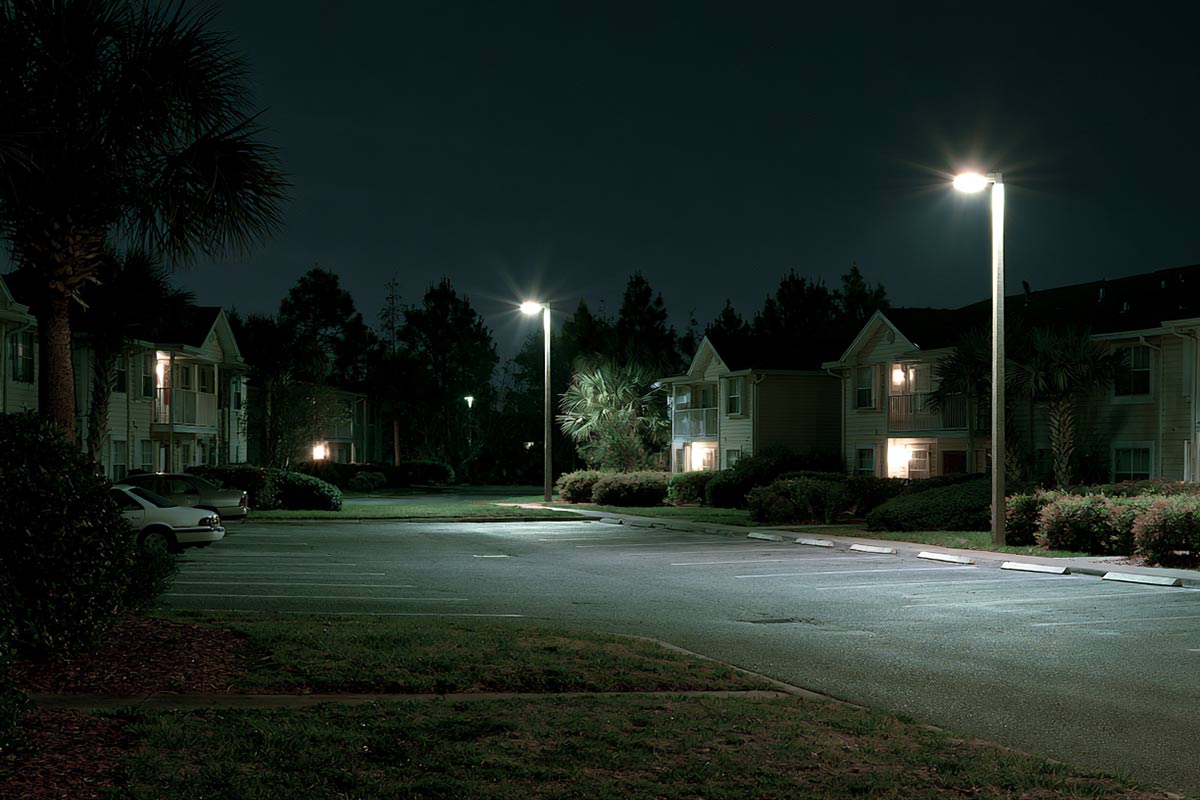
If the statutory scorecard identifies what fails most often, the lighting category identifies where the money goes. Among the 23 existing properties with open parking lots, 20 (87%) measured below the statutory 1.8 foot-candle average, and 22 (95.7%) fell below the Illuminating Engineering Society’s recommended practices for the relevant applications. More significantly for budgeting purposes, 21 of 26 existing properties (80.8%) exhibited property-wide lighting deficiencies serious enough to require an engineered redesign of the outdoor lighting system—not spot repairs, but photometric analysis, new fixture schedules, and in many cases new poles and circuits. Add the accumulated fixture-repair backlog we typically document (279 individual fixture-level deficiencies across the sample: inoperative pole lights, degraded wall packs, dark breezeways, fixtures obstructed by tree growth) and lighting emerges, by a wide margin, as the dominant capital item in HB 837 remediation.

So what does correction cost? For this question, we turned to Ecofi, a lighting design firm we’ve worked with on remediation projects for multiple clients, who generously shared cost data from their project records. Across 181 analyzed lighting improvement projects serving 32,663 total units, project costs ranged from $10,000 to $100,000, with an average final contract value of $52,656—approximately $321 per unit. That per-unit figure is the single most useful budgeting heuristic in this article. An owner of a 250-unit garden community facing a property-wide lighting finding can reasonably anticipate a project on the order of $80,000; a 100-unit property, roughly $32,000. Actual costs will vary with site conditions, but Ecofi’s per-unit average provides a good metric for preliminary budgeting.

Ecofi’s data also reveals a pattern worth attention when anticipating your own exposure: average project cost varies substantially by the property’s year of construction. Remediation costs peak for properties built between roughly the mid-1980s and mid-2000s, where the trend line runs near $70,000-$73,000 per project, remain moderate for older stock, and decline steeply for post-2010 construction, falling toward $30,000. Older fixture technology is one type of contributing factor. Spacing between lights in relation to their luminous flux (light output) is another. This combination of problems is often easily diagnosed after our field assessment when analyzing spreadsheet data of our light measurements: on older properties, it is common to find fewer than 10% of meter readings meeting statutory or IES guidelines, with extended rows of measurements catalogued at 0.0 fc (dark enough that the light meter rounded down to zero).

The following chart provides a summary of compliance problems related to lighting in our dataset.

Camera Systems: The Widest Cost Variance

Camera remediation displays the widest cost variance of any category in our client records: actual corrective projects ranged from $2,000 to $50,000. The variance reflects the difference between filling coverage gaps and replacing systems. A property with a functioning modern system that simply lacks coverage at one “point of entry or exit” faces a modest project; a property with an obsolete analog system, or none at all, faces a full design-and-installation effort at the top of the range.

But even within gap-filling projects, site conditions drive order-of-magnitude differences. A simple camera installation mounted to a clubhouse—existing structure, available power, short cable run—may cost less than $1,000. A single camera covering an entry drive hundreds of feet from the nearest building may require a new pole, trenching to lay cable, or point-to-point wireless transmission hardware, pushing that one camera position to several thousand dollars. The lesson for budgeting is that camera costs are estimated per position and per pathway, not per device—the camera itself is frequently the cheapest component of the installation. For this reason, owners should treat any camera deficiency finding as a request for a site-specific quote rather than attempting to budget from equipment prices.

Following is a chart summarizing our findings regarding camera deficiencies identified in the dataset.

Landscaping, Maintenance, and Management Practices: Ubiquitous but Inexpensive

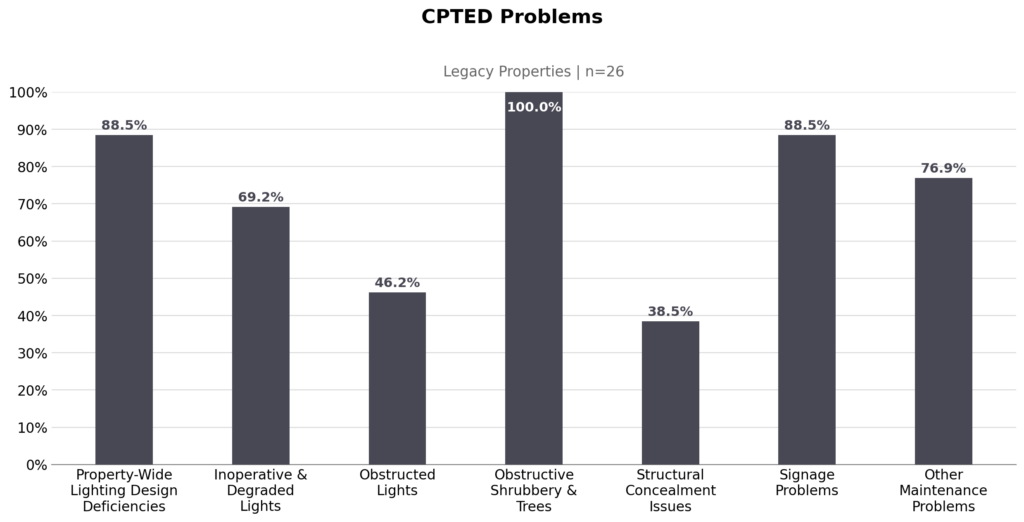
Here is the finding that dominates the raw numbers while barely denting the budget: landscaping and sightline problems appeared at every one of the 26 existing properties and accounted for 797 issue instances—more than half (53.5%) of every deficiency we documented in the entire study. Tall shrubbery obstructing natural surveillance was the second most prevalent individual problem in the dataset, appearing at 28 of 30 properties (93.3%) with 648 documented instances. Low tree canopies appeared at 60% of properties, and trees obstructing light fixtures—a problem that converts a landscaping maintenance issue into a lighting problem—at 40%.

The good news is that this most ubiquitous category is also the least expensive to correct. Landscaping alterations and tree pruning projects in our client records ranged from $1,000 to $7,000. The higher end of that cost spectrum encompassed larger properties and situations where existing plant species required replacement.

And unlike lighting or camera systems, landscaping correction is almost entirely preventable going forward at negligible cost. Which brings us to the most prevalent single finding in the entire study: at all 30 properties—100%, including the newly-constructed ones—the landscaping maintenance contract contained no specifications for maintaining shrubbery and trees according to CPTED guidelines. Groundskeepers were maintaining plant health and curb appeal because that is what their contracts asked of them. Nobody had asked them to maintain sightlines. Our consultants recommend that every property owner subject to F.S. 768.0706 revise their landscaping contract to include CPTED maintenance specifications—shrub height limits, canopy clearances, and fixture clearance requirements—so that a one-time corrective pruning project does not silently regrow into next year’s deficiency finding. A related management gap appeared at 30% of properties: no policy for documented inspection of security-relevant conditions (lighting outages, gate hardware, camera function) on a scheduled basis.

The same logic extends beyond vegetation to the property’s broader image and maintenance conditions. Signage problems appeared at 23 of 26 existing properties (88.5%), accounting for 56 issue instances—most commonly faded and sun-bleached signs (65.4% of properties), followed by missing no-trespassing signage (34.6%) and missing entrance identification (26.9%). General site maintenance findings appeared at 19 of 26 properties (73.1%): ground litter (53.8%), graffiti (23.1%), damaged site equipment, and abandoned objects. And damaged perimeter fencing appeared at 34.6% of properties, with another 11.5% exhibiting fencing compromised by vegetation growth. Individually, none of these findings carries a meaningful price tag—sign replacement, litter policing, and fence repair are maintenance-budget items, not capital projects. But collectively they matter more than their costs suggest. In CPTED terms, these are image-and-maintenance deficiencies: conditions that signal to prospective offenders how closely a property is supervised, and faded signage communicates much the same message as an unsecured gate.

Following is a summary of our findings regarding CPTED matters outside the purview of statutory compliance.

New Construction: Cleaner, Not Perfect

CIS provided plan review and specifications during the design process for two out of the four newly constructed properties in the dataset. The other two were constructed with statutory compliance as an objective, but without our direct input or guidance.

None of the four measured below the statutory parking-lot lighting standard—modern photometric design earns its keep—and their overall issue intensity was dramatically lower, averaging roughly 8-21 instances per 100 units against a 33-instance average for existing properties. But all four had light switch problems, two of four fell below IES lighting guidelines, and one had absent camera coverage at a “point of entry or exit.”

Three of the four had instances of obstructive shrubbery, but at far lower intensity than the legacy properties—legacy: 12.5 instances per 100 units; new construction: 2.6 (pooled).

Putting the Budget Together

So what should an owner entering this process actually anticipate? Issue intensity in our sample averaged 33 instances per 100 units across existing properties, but varied predictably by property character: mid-rise properties averaged about 25 instances per 100 units, garden communities about 36, and bungalow-style properties about 43—sprawling low-rise sites simply present more lighting, landscaping, and perimeter surface area per unit. By leasing category, market-rate properties averaged about 14 instances per 100 units, affordable/tax-credit properties about 31, and public housing about 51, though the market-rate and public-housing figures rest on small subsamples and should be treated as directional.

For the corrective budget itself, the data supports a three-tier expectation. First, near-certain and inexpensive: landscaping alterations ($1,000-$7,000), switch security corrections, signage replacement, and a revised landscaping contract—corrections nearly every property will need and most can absorb within existing maintenance budgets. Second, probable and variable: camera system corrections ($2,000-$50,000 observed range), where roughly three-quarters of existing properties had findings and cost depends entirely on site conditions and system age. Third, probable and capital-scale: lighting improvements ($10,000-$100,000 observed range, $52,656 average, roughly $321 per unit), where four out of five existing properties required engineered redesign. An owner who budgets against the per-unit lighting heuristic, obtains site-specific camera quotes, and folds the landscaping corrections into routine maintenance will rarely be surprised by the remediation phase of this process.

For owners beginning this process, CIS provides CPTED assessments for F.S. 768.0706 compliance conducted by our team of Florida CPTED Practitioners, along with remediation planning support and reassessment services under extended agreements. But whoever conducts your assessment, the arithmetic in this article points to one conclusion: the owners who struggle with compliance are rarely the ones with the worst deficiencies. They’re the ones who budgeted for none.

Contact Us 

Contact us for a free consultation about Fla. Stat. § 768.0706 compliance by calling Tel. +01 (727) 461-9417 or by completing the following form:
Craig

Craig Gundry Presents “Fla. Stat. 768.0706: Three Years Later” at FLDOCA Spring Conference

Craig Gundry Presents “Fla. Stat. 768.0706: Three Years Later” at FLDOCA Spring Conference

On May 8, 2026, Craig S. Gundry, PSP, FCP, of Critical Intervention Services participated in a panel of field practitioners discussing Florida Statute 768.0706 at the Florida Design Out Crime Association (FLDOCA) Spring Conference in Orlando. The panel, presented under the title “Fla. Stat. 768.0706: Three Years Later,” examined the state of multifamily compliance three years after the statute’s passage as part of HB 837 in 2023. Joining Craig on the panel were Leon Lipsick, FCP, West Palm Beach Housing Authority; Carlos Austin; and Stephen Davis.

The FLDOCA Spring Conference was held at the DoubleTree by Hilton Orlando at SeaWorld, co-located with Florida Crime Prevention Training Institute (FCPTI) courses conducted during the same week. The conference program brought together Florida CPTED practitioners, law enforcement crime prevention specialists, and security professionals from across the state, with additional presentations addressing the USCA CPTED National Design Guidelines and the integration of CPTED into community development planning.

Craig’s presentation reviewed the current status of 768.0706 compliance across Florida’s multifamily sector. Although an increasing number of private equity and property management companies have pursued compliance since the statute’s enactment, the overall number remains low, with much of the existing interest driven by insurance brokers and risk advisors rather than the property operators themselves.

The presentation also addressed HB 1423 and SB 956, companion bills introduced during the legislative session that would have eliminated the presumption against liability for properties where two or more enumerated crimes were reported in the 24 months preceding an incident. Both bills were stopped, but their introduction signals that the statute’s liability framework will remain a subject of legislative attention.

A substantial portion of the discussion focused on the unresolved definitional questions in F.S. 768.0706(2)(a) — ambiguities that have received no substantive clarification since 2023. These include what constitutes a “point of entry and exit” for camera coverage purposes, the unusual 1.8 foot-candle at 18-inch measurement standard for parking lot illumination, and the statute’s undefined use of the term “porches” in its common-area lighting requirement. In the absence of case law or legislative guidance, CIS has developed documented interpretive positions on each of these questions for use in our assessment practice, and the panel discussed how practitioners across the state are navigating the same interpretive gaps.

The presentation concluded with a review of CPTED assessment practice in multifamily environments — natural surveillance and obstructive vegetation, offender concealment opportunities, lighting deficiencies commonly documented during nighttime inspections, territoriality measures, and maintenance conditions — along with practical guidance for maintaining substantial compliance over time through documentation systems, sustained employee training, landscaping contract specifications, and monthly inspection protocols.

CIS thanks FLDOCA for organizing the program and our fellow panelists for a candid exchange on the practical realities of statutory compliance. Craig serves on the FLDOCA board of directors, and CIS remains active in the association’s work advancing CPTED practice throughout Florida.

For property owners and operators seeking guidance on 768.0706 compliance, our six-part compliance guide and CPTED assessment services page.


Contact Us 

Contact us for a free consultation about Fla. Stat. § 768.0706 compliance by calling Tel. +01 (727) 461-9417 or by completing the following form:
Craig

CIS Consultants Featured on the Property Management Law Solutions Podcast

CIS Consultants Featured on the Property Management Law Solutions Podcast

Critical Intervention Services security consultants Craig S. Gundry, PSP, FCP, and Hector Rodriguez, CPP, FCP, were recently featured guests on the Property Management Law Solutions Podcast, hosted by attorney Tim Baldwin. The episode, titled “Liability & Risk Management for Property Management Companies,” was released on June 10, 2025 and is available on all major podcast platforms.

The Property Management Law Solutions Podcast is produced by Property Management Law Solutions, PLLC, a Florida law firm specializing in landlord and property management representation statewide. Tim Baldwin, the firm’s founder, has been practicing law since 2004 and represents some of the largest property management companies in Florida. His podcast addresses the legal and operational issues confronting landlords and property managers, ranging from evictions and lease compliance to insurance and premises liability.

During the interview, we discussed the liability landscape facing property management companies in Florida and the practical measures available to reduce exposure to negligent security claims. Much of the conversation centered on Florida Statute 768.0706 — the multifamily premises liability law established by HB 837 in 2023 — and the framework it provides for property owners seeking a presumption against liability for criminal acts committed by third parties on their premises. As we’ve noted in our published compliance guides, the statute’s seven enumerated physical security measures are only the starting point. The CPTED assessment requirement, the employee training obligation, and the ongoing burden of demonstrating substantial compliance are where most properties encounter difficulty, and these were recurring themes throughout the discussion.

We also addressed the practical relationship between property managers and security consultants when preparing for compliance. Although the statute places the burden of proof on the owner or principal operator, property management companies are typically the parties responsible for day-to-day compliance activities — camera system checks, lighting inspections, landscaping maintenance according to CPTED assessment guidelines, and documentation of improvements. In our experience conducting CPTED assessments across Florida, properties that treat these obligations as an ongoing operational commitment are far better positioned to withstand court scrutiny than those that approach compliance as a one-time checklist.

Conversations like this one reflect a broader point we frequently make with clients: liability risk management in the multifamily sector is fundamentally a collaboration between legal counsel, property operators, and qualified security practitioners. Attorneys like Tim Baldwin understand the litigation environment; our role as Florida CPTED practitioners is ensuring that the physical security conditions and documentation on the ground can support the legal defense when it matters.

The full episode is available on the Property Management Law Solutions Podcast website, Apple Podcasts, Spotify, Amazon Music, and iHeartRadio. We thank Tim Baldwin for the invitation and for his continued work educating Florida’s property management community on these issues.

For more information about CIS’s Florida CPTED assessment services and Fla Stat 768.0706 compliance, visit our compliance guide or contact our office.

Contact Us 

Contact us for a free consultation about Fla. Stat. § 768.0706 compliance by calling Tel. +01 (727) 461-9417 or by completing the following form:
Craig

CIS and S2 Institute Launch Free ‘Proper Crime Deterrence and Safety Training’ for Compliance with Florida Statute 768.0706(2)(c)

CIS and S2 Institute Launch Free ‘Proper Crime Deterrence and Safety Training’ for Compliance with Florida Statute 768.0706(2)(c)

Training Now Available On-Demand at www.HB837training.com 

Clearwater, FL, September 12, 2024 — Critical Intervention Services (CIS), in partnership with the S2 Institute, proudly announces the launch of an on-demand Crime Deterrence and Safety Training program, available now at www.HB837training.com. This comprehensive training is free to the public until January 1, 2025, and is designed to help organizations comply with Florida Statute 768.0706(2)(c). 

A major benefit for management companies: CIS clients who have undergone a Crime Prevention Through Environmental Design (CPTED) assessment will receive unlimited, no-cost access to this training for their employees — permanently. This unique offering ensures management companies can provide continuous safety training without incurring additional costs, enabling them to stay compliant with Florida Statute 768.0706(2)(c) and protect both current and future employees. 

Starting January 1, 2025, the training will be available to non-CIS clients for a fee of $35.00 per employee. 

Comprehensive Crime Prevention Training

The training program, based on the proposed curriculum developed by the Florida Crime Prevention Training Institute (Department of Legal Affairs), covers critical strategies to prevent and respond to crime. Upon completion, participants will receive a certificate of completion, providing proof of their commitment to safety and preparedness. 

CIS, known for its expertise in specialized security and safety solutions, including CPTED assessments, designed this program to deliver practical crime deterrence techniques that enhance safety and awareness across multifamily environments. 

Exclusive Features for Management Companies

For management companies, the training comes with enhanced benefits, including an online administrative portal for streamlined oversight. This portal allows management teams to monitor employee progress, ensuring full compliance with training requirements. Additionally, it provides on-demand access to training records, simplifying the retrieval of important documents as needed. 

Through this administrative portal, management companies can enjoy complete transparency in tracking training progress, ensuring accountability and timely completion of required courses. 

Enroll Today

The Crime Deterrence and Safety Training is available now at www.HB837training.com. Enrollment is open to all multifamily management companies, their employees, and the general public. Take advantage of this free offer before it expires on January 1, 2025.

New Guide to Compliance with Florida Statute 768.0706 (HB 837)

New Guide to Compliance with Florida Statute 768.0706 (HB 837)

In May 2024, CIS published a comprehensive online guide to assist property owners in developing an informed strategy for compliance with Florida Statute 768.0706.

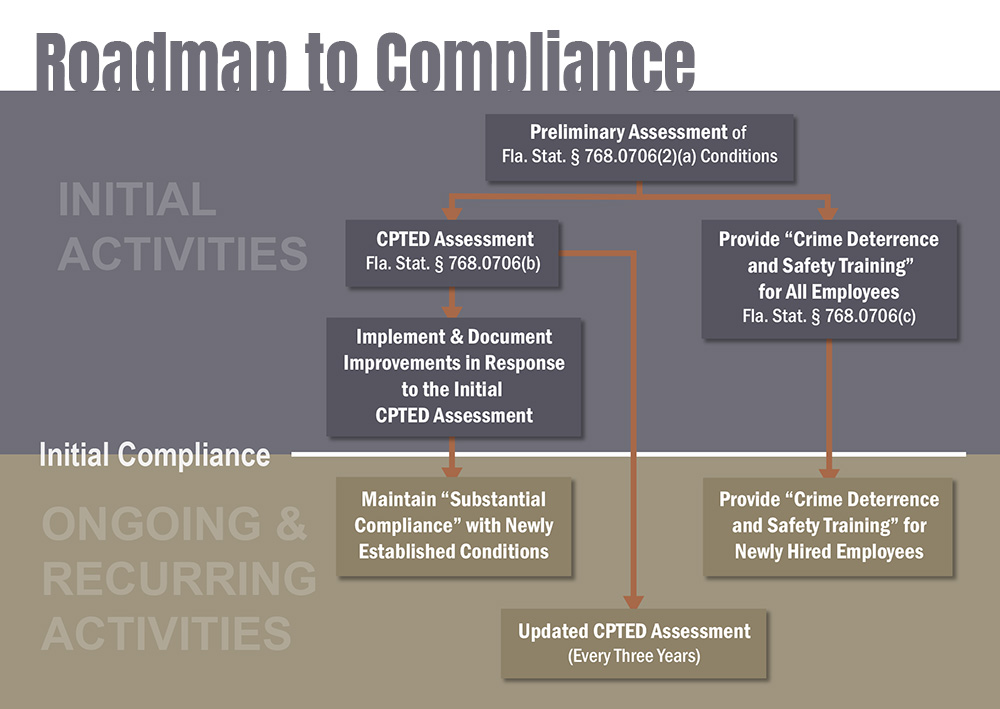
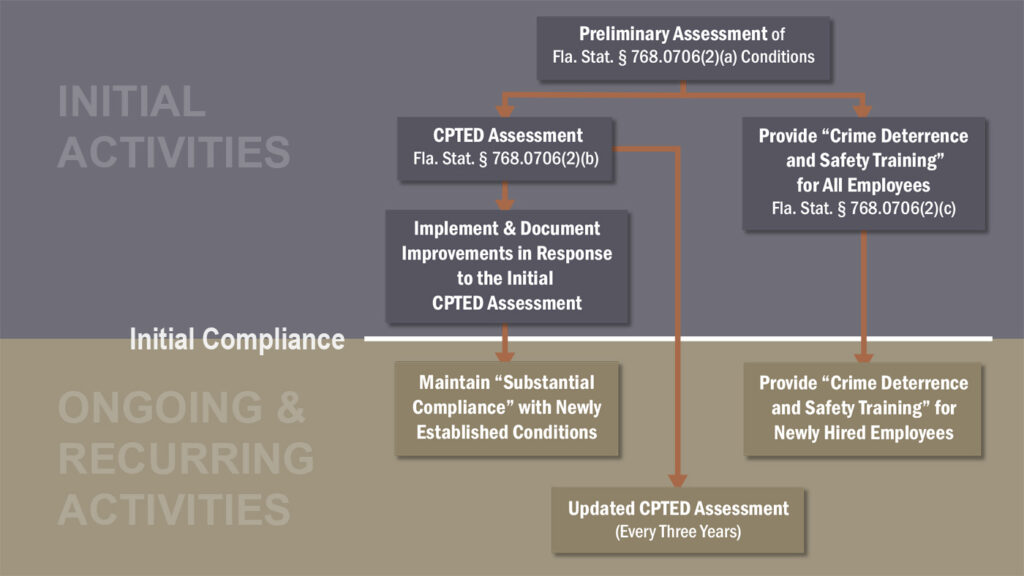
The new guide presents a complete roadmap to compliance beginning with cost-benefit analysis and initial considerations, conducting a preliminary compliance assessment, CPTED assessment, implementation and documentation of improvements, “proper crime deterrence and safety training” for employees, and maintaining ongoing compliance moving forward.

The new guide also explores a number of ambiguities in the statute, strategies for demonstrating “substantial compliance” as required by the law, and approaches for reinforcing defensibility against future court challenge.

Click here to view the web version.

Click here to download the PDF version.

CIS: Elevating HB 837 Compliance and Reporting Standards in Florida

CIS: Elevating HB 837 Compliance and Reporting Standards in Florida

TAMPA, Fla., March 12, 2024 /PRNewswire/ — In a landscape where safety and compliance are more critical than ever, Critical Intervention Services (CIS) stands out not only as a leader but also as the largest HB 837 compliance consulting firm in Florida. With a steadfast commitment to mitigating risk, CIS delivers on this promise through a blend of unmatched expertise, a comprehensive approach to security and legal compliance, and a dedication to excellence that spans over three decades. Specializing in multi-family housing security, CIS has made its mark by working in thousands of communities, offering unparalleled protection and strategic advantages to property owners and operators throughout the state.

The enactment of Florida House Bill 837 (HB 837) in March 2023 has introduced new benchmarks for apartment and multifamily property owners, mandating stringent crime prevention measures. CIS leverages its unparalleled expertise and the largest team of specialized consultants in the state to ensure that compliance extends beyond mere adherence to standards. “We solidify our clients’ liability protections by meticulously preparing their certifications to meet HB 837 requirements,” emphasizes the service’s anticipatory nature, designed to meet and surpass the needs and challenges of compliance and legal defense.

“Our philosophy, ‘Discover the Critical Difference,’ is woven into every aspect of our work,” said KC Poulin, CEO & President of CIS. “This means not just achieving compliance but crafting a strategic shield that protects properties against both crime and future legal challenges. Our extensive experience and proactive approach ensure our clients’ peace of mind, knowing they’re fortified against potential risks.” CIS’s strategic foresight in preparing reports and certifications, designed to withstand legal scrutiny, sets a new industry standard. This attention to detail and preparation underscores the critical difference CIS brings to its clients, offering an unmatched level of protection and assurance.

For property owners and operators seeking to navigate the complexities of HB 837 with confidence, CIS’s proven track record and the promise of discovering the critical difference make it the go-to consulting firm in Florida. Detailed information on how Critical Intervention Services can support your community in leveraging HB 837 for enhanced safety and legal protection is available on our resource page: CIS HB 837 Assessment and Crime Prevention.

About Critical Intervention Services (CIS)

For over 30 years, Critical Intervention Services (CIS) has been at the forefront of security and safety consulting for multi-family housing environments. As the largest HB 837 compliance consulting firm in Florida, CIS boasts an unparalleled team of specialized consultants, offering in-depth solutions for property owners and operators aiming to enhance their safety and legal protection.

What to expect from an HB 837 CPTED Assessment?

What to expect from an HB 837 CPTED Assessment?

Since HB 837 was signed into law in March 2023, many apartment owners and property management companies throughout the State of Florida have awakened to the powerful liability protections provided by the new statutes. Just in the past month, our firm has spoken with a half dozen companies eager to get started as soon as possible.

While many seem to have a sense of where they stand regarding most measures described in F.S. 768.0706(2)(a), few arrive with an understanding of what is encompassed during a Crime Prevention Through Environmental Design (CPTED) assessment and the types of issues they may be expected to address while improving their properties for compliance.

The following article is written to provide an understanding of the assessment process, common CPTED guidelines that will likely influence the observations of the Florida CPTED Practitioner, and some specific nuances regarding HB 837 that should be considered when initiating assessments.

Verification of F.S. 768.0706(2)(a) Compliance versus CPTED Assessment

As a preliminary point, there is a difference between compliance with F.S. 768.0706(2)(a) and compliance with common guidelines in CPTED. Some property owners we’ve spoken with believed that if they were compliant with the seven defined measures in F.S. 768.0706(2)(a) (e.g., 1-inch deadbolt throws, peepholes, pool access, etc.), they would naturally be compliant with CPTED guidelines as well. That’s a false assumption.  

With the exception of lighting, there are few measures in F.S. 768.0706(2)(a) that directly correspond with CPTED practices. And even on the subject of lighting, there are important differences that property owners should be aware of.

When approaching a Florida CPTED Practitioner (FCP) for an assessment, it’s important to clarify the scope as related to the measures defined in F.S. 768.0706(2)(a). The statute only states: “By January 1, 2025, the owner or principal operator of a multifamily residential property has a crime prevention through environmental design assessment that is no more than 3 years old completed for the property.” It does not state that the documented CPTED assessment must also encompass the seven measures stated in F.S. 768.0706(2)(a).

However, most clients we have spoken with want both—a CPTED assessment that meets the requirements of F.S. 768.0706(2)(b) and a written document verifying their compliance with the measures in F.S. 768.0706(2)(a). From a practical perspective as a scope of work, verifying compliance with F.S. 768.0706(2)(a) as an additional activity is largely a matter of some extra work time. However, there is one topic where the difference is important.

During CPTED assessments, illumination in parking lots is normally measured at surface level and 5-feet vertical from surface in accordance with guidelines by the Illuminating Engineering Society (IES). However, to verify compliance with HB 837, illumination in parking lots needs to be measured at 18-inches from ground. Although this may sound like a minor technical matter, the cost of work time for measuring and documenting illumination levels at both heights would result in double the normal price for a parking lot lighting assessment. As a result, if HB 837 verification is part of the scope, most Florida CPTED Practitioners will choose to approach the parking lot lighting assessment using the HB 837 requirement rather than standard IES guidelines.

The HB 837 CPTED Assessment Process

Following is a description of how a typical CPTED assessment of a multifamily property would be conducted, including in this example verification of HB 837 compliance.

As a preceding matter, the Florida CPTED Practitioner should retrieve a crime report for the property and surrounding area to identify any unique conditions warranting special consideration during the on-site assessment. In alignment with practices promoted by the Florida Crime Prevention Training Institute (FCPTI), the crime analysis should encompass current statistics in addition to a 5-year historical trends analysis.

The on-site assessment typically commences with a meeting with the property manager to review background information about the property and identify any unique concerns. After the manager interview, the CCTV system is evaluated for compliance with requirements defined in F.S. 768.0706(2)(a)(1). Although we normally prefer to evaluate CCTV under nighttime conditions during our comprehensive property inspections, daytime CCTV assessment is more convenient for property managers if the main objective is to only verify compliance with HB 837’s coverage requirements.

Afterward, a physical inspection of the property is conducted to evaluate CPTED conditions and compliance with requirements defined in F.S. 768.0706(2)(a). Some of these compliance verification activities should include inspection of the pool area and residential units for conditions as required under F.S. 768.0706(2)(a).

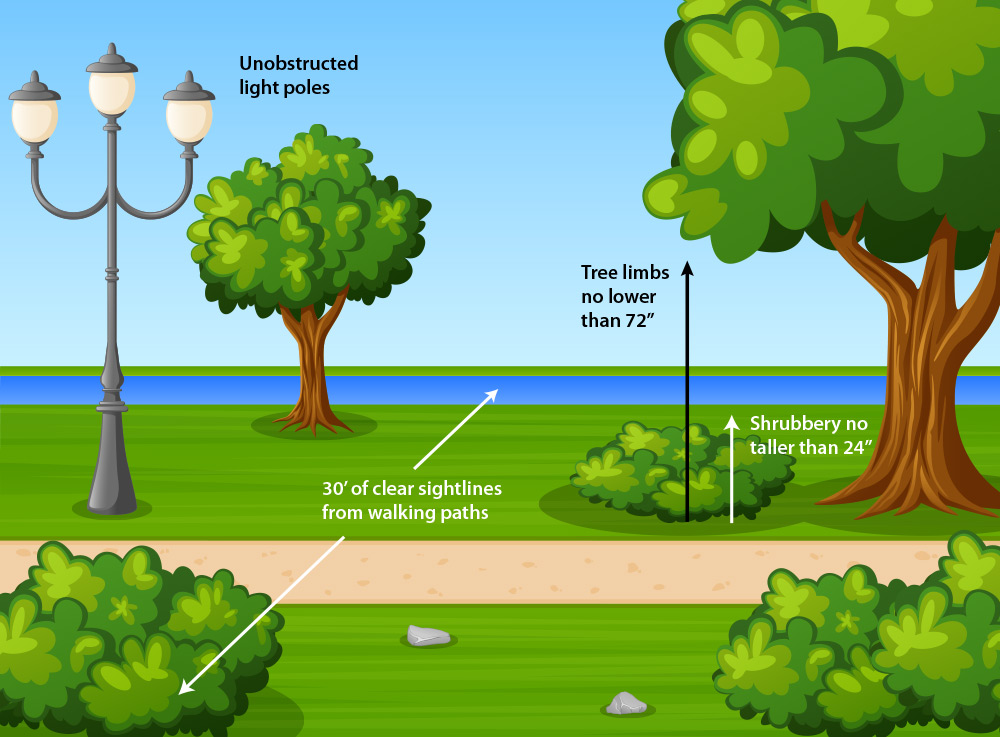
A major focus of CPTED surveys in multifamily properties is landscaping design and its influence on “natural surveillance”—ensuring unobstructed sightlines throughout the property to reduce offender concealment opportunities and facilitate observation of criminal activity. For this purpose, FCPTI promotes the ‘2ft-6ft rule’ whereby all hedges and bushes should be no taller than 24” in height and tree limbs should be no lower than 72” from the ground. As a property owner, expect that any shrubbery and trees that deviate from this guide will appear in the report.

The Illuminating Engineering Society also promotes a similar guideline (3ft-7ft rule), but most Florida CPTED Practitioners use the 2ft-6ft rule when doing assessments to ensure best conformity with guidelines promoted by the Florida Crime Prevention Training Institute (FCPTI).

In addition to the 2ft-6ft rule, CPTED guidelines promoted by FCPTI also include the 30-ft sightline rule. Under the 30-ft sightline rule, there should be 30 feet of unobstructed sightlines along the sides of all sidewalks and walking paths.

In addition to maintaining clear sightlines, all trees located near light poles should be trimmed in a manner that luminaires are unobstructed and branches don’t cast shadows below.

HB 837 CPTED assessment - Landscaping Issues

Following are some examples of trees and shrubs that would be documented unfavorably in a CPTED assessment report.

In addition to landscaping issues, the property features and buildings are examined for possible offender concealment opportunities with special focus on common areas and pedestrian walkways. Below are some examples of offender concealment opportunities that would likely be documented in a CPTED assessment report.

Other issues encompassed during daytime assessments often include signage and “wayfinding measures, territorial definition, natural access control, and property maintenance.

After dusk, the assessment continues with a lighting assessment. If HB 837 verification is part of the scope, the Florida CPTED Practitioner will likely approach the parking lot independently by measuring illumination levels metered at 18-inches from ground surface (as required for establishing compliance with F.S. 768.0706(2)(a)(2)). Some CPTED practitioners grid parking lots for assessment. Others, such as CIS, prefer to meter each parking space independently when establishing an average illumination level for the highest degree of comprehensiveness and accuracy.

After the parking lot lighting survey is complete, the lighting assessment continues with focus on sidewalks, building entrances, mailboxes, and outdoor activity areas. In following with FCPTI guidelines, illumination levels in these areas are metered according to criteria established by the Illuminating Engineering Society (IES) and recorded. If HB 837 compliance is part of the scope, the Florida CPTED Practitioner would also be verifying the presence of lighting in walkways, laundry rooms, common areas, and “porches” as required by F.S. 768.0706(2)(a)(3).

When the final report is delivered, a lighting map should be included identifying illumination levels in locations throughout the property and additional observations regarding contrast ratio, glare, light trespass, and maintenance issues such as degraded and burned out lights.

Legal Defensibility, HB 837, and Assessment Reports

Although HB 837 provides robust protection to property owners against frivolous lawsuits resulting from criminal activity, it is naturally expected that plaintiff attorneys will attempt to undermine HB 837’s liability shield by claiming that the defendant’s properties are non-compliant with requirements of the statutes. And one possible angle for establishing the appearance of non-compliance is discrediting the CPTED assessment performed by the Florida CPTED Practitioner and methods used for verifying and documenting compliance during the inspection.

As a starting point, property owners should ensure that the Florida CPTED Practitioner is conducting the assessment and making observations in close alignment with guidelines and practices promoted by the Florida Crime Prevention Training Institute (FCPTI). Although FCPTI is not directed under the statute to establish standards for assessments, the Florida Crime Prevention Training Institute (FCPTI) is directly referenced twice in the statute and will naturally be cited as an authority for standard of care by experts in legal proceedings.

When selecting a Florida CPTED Practitioner as a consultant, it is highly recommended that property owners view an example of the consultant’s written work product to examine the practitioner’s attention to defensibility in court. Following are some questions to consider when evaluating prospective consultants and examining their CPTED reports:

    • Does the Florida CPTED Practitioner have experience with premises liability cases? Better yet, do they have courtroom experience as an expert witness? Assume that the practitioner’s CPTED report will be challenged and if so, it’s very likely the consultant will be called to testify.
    • Is the light meter used by the consultant calibrated and NIST-certified for accuracy? If not, this opens an opportunity for discredit by an opposing Plaintiff’s expert.
    • Is the report accompanied by appendixes or footnotes defining the CPTED standards and authoritative sources as basis for his/her observations?
    • How does the Florida CPTED Practitioner address property features that cannot be changed without major redesign of the site or reconstruction of buildings? Be aware that some measures encompassed under CPTED doctrine relate to the original property design and cannot be reasonably addressed without very major expense. However, omitting the presence of these types of conditions in a CPTED report provides an angle of opportunity for an opposing expert seeking to discredit the assessment (i.e., “Respectfully, the assessment is incomplete, counselor.”). How does the consultant address this type of situation in their reports to ensure comprehensiveness while also managing foreseeability?
    • What is the “quality” of the report documentation? Although they say “Justice is blind,” appearance does matter in the eyes of judges and juries. How well written is the report regarding format & organization, clarity, articulation with attention to potential court interpretation, grammar, and aesthetic design?

Contact Us 

Contact us for a free consultation about Fla. Stat. § 768.0706 compliance by calling Tel. +01 (727) 461-9417 or by completing the following form:

Craig

Florida House Bill 837 (HB 837) and Apartment and Multifamily Properties: Walk, Don’t Run

HB 837 Multifamily Properties

Florida House Bill 837 (HB 837) and Apartment and Multifamily Properties: Walk, Don’t Run

Florida House Bill 837 (HB 837) aims to reduce liability risks for apartment and multifamily housing property owners who implement specific crime prevention measures based on Crime Prevention Through Environmental Design (CPTED) principles and have a documented CPTED assessment. To comply with Florida House Bill 837 and reduce your security and crime-related liability risks, ensure your properties meet the following physical property requirements:

    • Install security camera systems at points of entry and exit, with footage maintained for at least 30 days.
    •  Ensure the parking lot is well-lit with an average intensity of at least 1.8 foot-candles per square foot at 18 inches above the surface, from dusk until dawn or controlled by photocell or similar technology.
    • Provide adequate lighting in walkways, laundry rooms, common areas, and porches, with illumination from dusk until dawn or controlled by photocell or similar technology.
    • Install at least a 1-inch deadbolt in each dwelling unit door.
    • Provide locking devices on all windows, exterior sliding doors, and any other doors not used for community purposes.
    • Install locked gates with key or fob access along pool fence areas.
    • Place a peephole or door viewer on each dwelling unit door without a window or without a window next to the door.

In addition to these physical measures, property owners must comply with the following procedural requirements:

    • Obtain a CPTED assessment completed and documented by a law enforcement agency or a Florida Crime Prevention Through Environmental Design Practitioner (FCP) no more than three years old. F.S. 768.0706(2)(b) further requires that property owners remain in mostly in “substantial compliance” with the assessment.
    • Provide proper crime deterrence and safety training to current employees by January 1, 2025. After this date, offer such training to all employees within 60 days of hiring.

Implementing these measures allows you to take advantage of the presumption against liability outlined in F.S. 768.0706(2) and reduce the risk of being held responsible for criminal acts committed by third parties on your property. Always stay informed about any updates or amendments to the bill, and consider consulting a legal professional from CIS to ensure full compliance.

It is highly recommended to conduct a preliminary assessment before the actual CPTED survey. This assessment helps property managers and owners determine the extent of work needed to achieve compliance and establish whether it is realistically possible to become compliant. Beyond the itemized conditions specified in HB 837, Florida Crime Prevention Through Environmental Design assessments encompass a much broader range of issues (e.g., landscaping design and maintenance, illumination in areas other than parking lots, etc.) and property owners will be expected to be in compliance with far more conditions than suggested by the list in F.S. 768.0706(2). Engaging in a documented CPTED assessment without knowing the costs and implications of compliance could lead to increased liabilities and vulnerability to plaintiff attorney complaints if the property fails to meet the required standards.

To minimize potential liability risks, consider the following steps before engaging in a full CPTED assessment:

    1. Perform a preliminary assessment with a qualified security professional: Review the requirements of HB 837 and evaluate your property’s current security measures against the criteria specified in F.S. 768.0706(2) and common CPTED standards. This will help identify areas that need improvement.
    2. Consult with a professional: Seek advice from a property management consultant, security expert, or legal professional to discuss your preliminary findings and understand the potential consequences of non-compliance.
    3. Develop a plan: Based on the self-assessment and expert advice, create a plan outlining the steps, resources, and timeline needed to bring your property into compliance.
    4. Communicate with stakeholders: Inform your team, residents, and other relevant parties about the planned improvements and their potential impact on property operations and safety.
    5. Monitor progress: Regularly review the implementation of the plan to ensure that improvements are made according to the established timeline, and adjust the plan as needed.

By taking these steps, you can minimize potential liability risks and be better prepared for a formal CPTED assessment. Keep in mind that achieving compliance is an ongoing process that requires continuous monitoring and improvement. Stay informed about any updates or amendments to HB 837 and collaborate with experts and local authorities to maintain a safe and secure environment for your residents.

Facebook
Twitter
LinkedIn
Email