Which employees must receive the training?
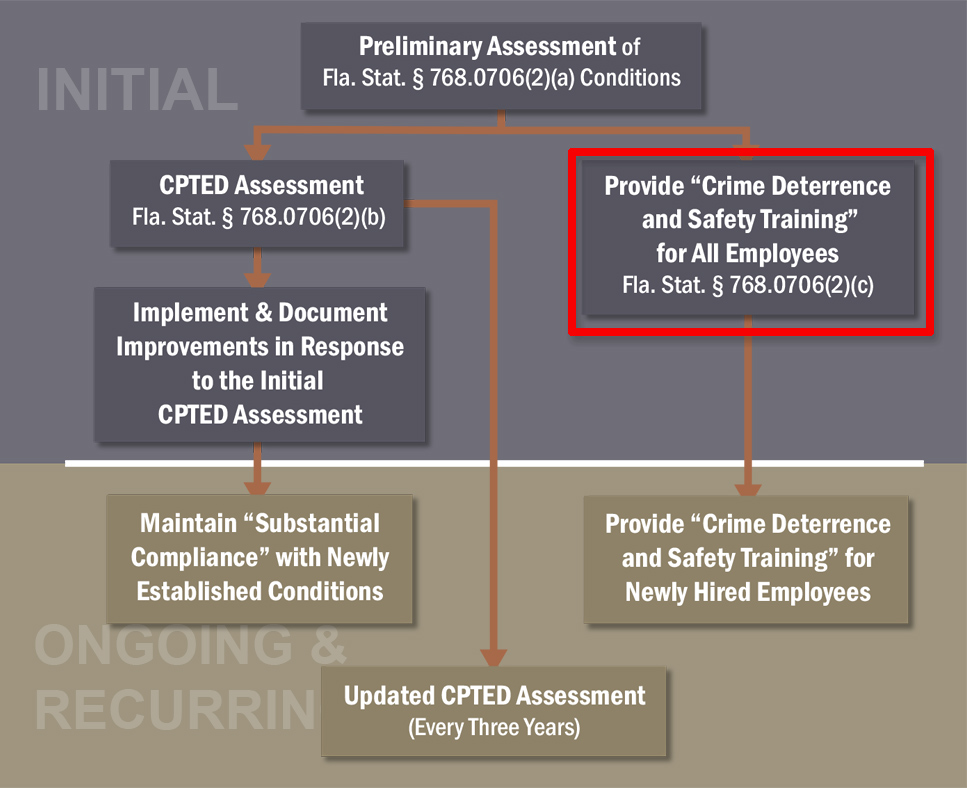
All current employees of the property, with every new employee trained within 60 days of hire. The statute does not carve out roles — office staff, maintenance personnel, and leasing agents are all encompassed — and in practice this breadth serves the property well, since maintenance staff are often the people who actually notice the burned-out fixture or the propped gate. For staffing arrangements beyond direct employees (contracted personnel regularly working the property, for example), the statute’s language addresses employees; how it applies to contractors is a question worth raising with counsel, though extending the training to them costs little and strengthens the overall posture.
What must the training cover?
The statute requires “proper crime deterrence and safety training” without prescribing a curriculum beyond “the security principles, devices, measures, and standards set forth under paragraph (a).” The sound working standard is the training template developed by the Florida Crime Prevention Training Institute encompassing a review of the statute and systematic examination of the seven measures and standards described in Florida Statute 768.0706(2)(a). Whatever curriculum is used, it should be consistent, documented, and identifiable — a property that can produce the actual training content is in a far stronger position than one that can only assert training occurred. The statute also requires that the training is reviewed at least every 3 years and updated as necessary.
What training records should we keep?
A completion record for every employee: who was trained, on what date, using what curriculum — maintained in anticipation of a court challenge, because that is exactly where these records are examined. New-hire records matter particularly, since the 60-day requirement creates a per-employee deadline that turnover makes easy to miss; the training log should be part of the onboarding checklist, not a separate annual project. Retain records for departed employees as well. If an incident occurred during their tenure, their training status on that date is what the record needs to show.
Where can our employees complete the required training?
Critical Intervention Services, in partnership with the S2 Institute, offers an on-demand, video-based Proper Crime Deterrence and Safety Training program built specifically for Fla. Stat. 768.0706(2)(c) compliance, available at HB837training.com. The program is self-paced, produces completion documentation for your training records, and resolves the new-hire logistics problem — an employee hired mid-cycle completes the same training within their 60-day window without waiting for a scheduled session. Properties are free to use any training that satisfies the statute; we built this one because the training requirement was the compliance category most often left unresolved on the properties we assess.