What should a CPTED-compliant landscaping contract specify?
The trimming standards from your assessment, stated as contract terms rather than assumptions: shrubbery and hedges maintained at or below 24 inches, tree canopies pruned to no lower than six feet, and regular pruning around light poles and wall packs so growth never obstructs the luminaires. Landscapers should receive the specifications in writing — ideally integrated into the scope of work — and orally, because crews change and written instructions alone drift. This is the single highest-leverage maintenance document on the property: landscaping is where compliance degrades first and fastest, and a contract that encodes the assessment’s standards converts an ongoing vigilance problem into a vendor obligation.
Who in the organization should own compliance tracking?
Someone by name — the failures we encounter are almost never that no one cared, but that everyone assumed someone else was tracking it. The workable pattern assigns day-to-day verification at the property level (camera checks, lighting inspections, work orders) with periodic oversight at the corporate or portfolio level confirming the records exist and the cycles are being kept. The assignment should survive personnel changes: compliance ownership belongs in the position description, not the person. Management and ownership transitions are the moment of maximum risk — the incoming operator inherits the obligation and the documentation burden on day one, usually without a briefing.
What happens if conditions have degraded when a claim arises?
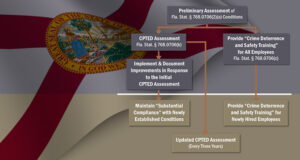
The statute requires that the property remain in substantial compliance with the assessment — and a claim is evaluated against conditions as they existed at the time of the incident, not as they existed on the day the report was delivered. Degraded conditions are precisely what a plaintiff’s team goes looking for: the burned-out fixtures, the camera that stopped recording, the hedges that grew back. A lapse does not automatically forfeit the presumption, but it hands the opposition an argument. The defense is unglamorous and effective — routine inspections, prompt work orders, and the log that proves both. Compliance is not a status the property achieved; it is a condition the property maintains.